
Showing posts with label interview. Show all posts

Wednesday, March 2, 2011

Conversation with Barbara Ehrenreich, Author of Nickel and Dimed, Bait and Switch

Barbara Ehrenreich is a journalist, lecturer, activist, and the author of over 20 books, but she is perhaps best known for 2001's Nickel and Dimed: On (Not) Getting By in America, an undercover report of the living and work conditions of America's minimum wage workers. Though academically trained in chemistry (Ehrenreich received a PhD from Rockefeller University in 1968), she switched focus toward social justice and shortly thereafter published her first title in the field, Long March, Short Spring: The Student Uprisings at Home and Abroad. Ehrenreich recently spoke by phone to discuss immersion journalism, the current recession, and 2005's Bait and Switch: The (Futile) Pursuit of the American Dream, an examination of the challenges of unemployed white collar workers.

BurnThroug
hBooks: How do you prepare--psychologically and logistically--to go into an undercover role?

Barbara Ehrenreich: It's something I've only done twice. With Nickel and Dimed I wasn't undercover; it was just me going out and getting those jobs. I was very unfamiliar with the genre, except for having read George Orwell's Down and Out in Paris and London, but I had read that for pleasure. I didn't have any models. With Bait and Switch, I had to go undercover. I changed back to my maiden name because I was pretty confident that I couldn't get get hired otherwise. So I had to fake a resume. In that case also I was a little concerned that my name might've been recognized.

I mainly faced things with dread. My writing life is very solitary and quiet. Suddenly, to be out there in the world, interacting with people, is kind of a rude shock, especially when you're doing it as someone else. I didn't know how to prepare myself. I had to find out more along the way. I didn't have the clothes. I thought what I considered professional clothes would be fine for being in the corporate role. I had to pay for a makeover. I had no idea. Dressing in a corporate way is like putting on a uniform, and every detail has to be right.

BTB: Comparing white collar job seekers' experiences with the subjects of Nickel & Dimed, do you think one demographic has an advantage over the other when it comes to support networks and access to job opportunities?

Ehrenreich: Unemployment right now, compared to 2004 and 2005, is running much higher for blue collar workers. This is a recession that has really slammed blue collar workers. Most white collar workers have the advantage of easy internet access. They have their own laptop and a desk and can search for jobs from home. Many blue collar workers have to go to a library to use a computer and find jobs. But white collar workers undergo very long periods of unemployment, especially if they're over 45. It could be terminal.

BTB: What do you think will be the breaking point in unemployment, when conditions become so strained for so many that the system is compelled to change? Is our economy in danger of approaching that point?
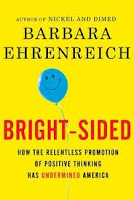
Ehrenreich: Are we in danger, or is it opportunity? I came away from Bait and Switch kind of amazed with how well corporate America has managed disappointment and despair in the workforce. It's a big effort. There are placement firms where people get pep talks; there's the whole positive thinking psychology, which was something that led to my next book, Bright Sided: How Positive Thinking is Undermining America. They work very hard to manage disappointment among white collar workers, and they do that by saying, "If you have a problem, it's your fault." That's worked for them so far. I'm trying to chip away at that.

BTB: I was interested to read in the book's introduction that this project was inspired by reader feedback to Nickel & Dimed. What other subjects for investigation have floated across your desk?

Ehrenreich: I have no more immersion journalism projects planned. Sometimes I get identified with that. If that's a way to get an answer, then I'll do it, but mainly I go from one book to another.

Sunday, February 27, 2011

Interview with John Burdett, Creator of Bangkok 8 Series


John Burdett is a British international lawyer, traveler, and practicing Buddhist best known for his creation of the Bangkok 8 detective series, a chilling and sometimes comic glimpse into crimes and corruption in Thailand's underworld. In addition, he is the author of The Last Six Million Seconds and A Personal History of Thirst. Mr. Burdett corresponded recently about his writing, meditation, and the latest installment in his series, The Godfather of Kathmandu.

BurnThroughBooks: What inspired you to feature Tibet so prominently in this new book?

John Burdett: Two things. I knew nothing of Buddhism, aside from a kind of hippy fashion statement in the seventies in north London, until I started researching the first Sonchai book. I began with the Dalai Lama's books and was surprised and impressed - but with all respect to him, it seemed obvious that he was aiming at a mainstream western audience. Soon I began to understand the difference between Theravada (which is the Thai form) and Mahayana, and felt obliged to concentrate on Theravada as it is practised here - for which I have a great deal of respect. At the same time I continued to make frequent visits to Nepal, which I had been visiting since 1982 and which is one of the first places of refuge for those fleeing Tibet. When I started looking around for themes for "Godfather", the Kathmandu/Tibetan connection was irresistible, along with the very exotic form of Mahayana they practice there.

BTB: I was really interested in the power of mantras, as described in this book. As a writer and meditator, what's your experience with centering and focusing tools?

JB: Briefly, what the ancients knew about the human mind, especially but not exclusively the Buddhists, is - well - mind blowing. Even a modest couple of steps on that path brings extraordinary results. One realises that the mind is universal - by shrinking it to conform with egoic and social needs one loses 99%, but this can be retrieved with these exercises. Mantras of course are merely one tool in the tool box; but with them one can begin to retrieve some of what has been lost in the modernist war on reality.

BTB: What do Thai and Western cops think of your portrayal of the Thai law enforcement culture?

JB: I try to follow Thai rules here: I make no negative comment about the royal family (I am in any case a strong admirer of the king) or the Sangha, but you only have to spend a short time in Thailand to realise that corruption in general and among the police in particular is a perennial topic of news and conversation - like the weather in England. Of course I use dramatic exaggeration to make the point, but the underlying theme is one which you find in the news daily and is frankly admitted by senior members of government. You may have heard of the "Hello Kitty" campaign designed to impugn the manhood of wayward cops. Not something you come across elsewhere as far as I know. I think those in the law enforcement industry understand very well where I'm coming from.

BTB: In an interview, you described your protagonist Sonchai Jitpleecheep as an offspring of your experience with vipassana meditation. Can you tell me about the earliest incarnation of this character? How did his character change between your first drafts and the publication of the first novel.

JB: I think my comment was probably meant to say that I often think of how the world looks if one is using a Buddhist perspective not merely as an intellectual exercise, but an imaginative one where you contrast the evolutionary opportunity of vipassana with the extremely abrasive experiences of everyday life. Naturally, since I try to meditate myself, Sonchai's day-to-day experiences change and develop along with my own. There is no constant but change.

BTB: How do you interpret Western audiences' appetite for the Buddhist perspective described in your novels?

JB: For a great many westerners, especially perhaps Americans, the post-Christian world has left a huge hole. A number are embracing Islam, others various forms of Christian and other cults. To my mind these alternatives still leave a gap between our Western scientific/analytical training, which has brought so much benefit in terms of technology, and the teaching of the prophets. In Buddhism there is no such gap: the Buddha had a very scientific mind and perfectly understood the power of logic to take us a good way along the path and to test our experiences. He just happened to be more advanced and courageous than our scientists: even logic dissolves in Emptiness - it's just that astro physics hasn't quite got there yet. Those elusive sub-atomic particles though, and the behaviour of photons: it looks like we're getting close.

BTB: Do you have any favorite spots in Bangkok that you'd recommend to new visitors and casual tourists?

JB: Everyone should make a river trip of one kind or another. If you don't like hackneyed tourist sites, just take a riverboat for about 5 Baht, and remember that for half a millennium Bangkok was a kind of Venice, where they used the klongs (canals) to get about.

John Burdett's next installment in the Bangkok 8 series, Vulture Peak, is due out January 2012.